Our History
 Our Church Our Church
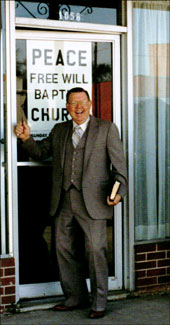
Peace Free Will Baptist Church was founded in November 1985. Its first meeting was held at Wayne 's Boot Store on W. Andrew Johnson Highway in Morristown . In December 1985, the church moved to a temporary location on S. Cumberland Street . Property was acquired at the present location, adjacent to Walters State Community College , and the church building was constructed.
The first service in the new sanctuary was held on November 15, 1987 . The founding pastor was Rev. Howard T. Munsey, who served the church until March 1994. Our current pastor, Christopher Dotson, has served the church since that time.
Peace Church is a growing congregation affiliated with the International Fellowship of Free Will Baptists. The church focuses on a strong teaching ministry and seeks to reach the community with the gospel of Jesus Christ. Pastor Dotson and the congregation extend to you a hearty welcome to worship during their services. Free Will Baptists
 T he Free Will Baptist denomination is a fellowship of evangelical believers united in extending the witness of Christ and the building of His Church throughout the world. The rise of Free Will Baptists can be traced to the influence of Baptists of Arminian persuasion who settled in the colonies from England. T he Free Will Baptist denomination is a fellowship of evangelical believers united in extending the witness of Christ and the building of His Church throughout the world. The rise of Free Will Baptists can be traced to the influence of Baptists of Arminian persuasion who settled in the colonies from England.
The denomination sprang up on two fronts at almost the same time. The southern line, or Palmer movement, traces its beginnings to the year 1727 when one Paul Palmer organized a church at Chowan, North Carolina. Palmer had previously ministered in New Jersey and Maryland, having been baptized in a congregation which had moved from Wales to a trace on the Delaware River in northern Pennsylvania.
The northern line, or Randall movement, had its beginnings with a congregation organized by Benjamin Randall June 30, 1780, in New Durham, New Hampshire. Both lines of Free Will Baptists taught the doctrines of free grace, free salvation and free will, although from the first there was no organizational connection between them.
The northern line expanded more rapidly in the beginning and extended its outreach into the West and Southwest. In 1910-1911 this body of Free Will Baptists merged with the Northern Baptist denomination, taking along more than half its 1,100 churches and all denominational property, including several major colleges. On December 28, 1916, at Pattonsburg, Missouri, representatives of remnant churches in the Randall movement reorganized into the Cooperative General Association of Free Will Baptists.
Free Will Baptists in the southeastern United States, having descended from the Palmer foundation, had often manifested fraternal relationships with Free Will Baptists of the Randall movement in the north and west; but the slavery question and the Civil War prevented formal union between them. The churches in the southern line were organized into various associations and conferences from the beginning and had finally organized into a General Conference by 1921. These congregations were not affected by the merger of the northern movement with the Northern Baptists.
Now that the remnants of the Randall movement had reorganized into the Cooperative General Association and the Palmer movement had organized into the General Conference, it was inevitable that fusion between these two groups of Free Will Baptists would finally come. In Nashville, Tennessee, on November 5, 1935, representatives of these two groups met and organized the National Association of Free Will Baptists.
This body adopted a Treatise which set forth the basic doctrines and described the faith and practice that had characterized Free Will Baptists through the years. Having been revised on several occasions, it serves as a guideline for a denominational fellowship which comprises more than 2,400 churches in 42 states and 14 foreign countries.
|